Showing posts with label Joe Pasternak. Show all posts

Monday, May 22, 2023

Miss Show Business

By the time Presenting Lily Mars was filmed in 1943, the twenty-year-old Judy Garland had already mastered the clowning, fumbling earnestness in her character’s single-minded pursuit of stardom and, for the first time on film, was displaying some of the world-weary show-biz brass that would point the way to her concert triumphs in middle age — that voice like a Big Band trumpet with a mute on it, moaning low or careening into the stratosphere. Chronologically, the Andy Hardy bloom was just barely off her, but she had come into her own mature talent, inexorably and rapidly. She had made an excellent picture the year before (For Me and My Gal, with Judy and Gene Kelly doing their “Ballin’ the Jack” routine) and had even separated from her first husband by then (having had an affair with Johnny Mercer in the interim). The character Garland plays in Lily Mars is a typical Booth Tarkington teenager, a homely duckling with a pie-in-the-sky dream and the gumption to chase it no matter how many obstacles she smacks into. There’s a lot of Alice Adams in Lily, but it isn’t high society Lily craves — it’s the energy that stage performers lap up from audiences (Garland took that energy and apotheosized it in 1961 at her famed Carnegie Hall concert).

A star is born. Judy Garland, Faye Bainter
I’ve always thought that Garland’s core was comedic rather than dramatic, despite her intelligence and honesty in serious roles like Esther, in A Star Is Born (1954). Garland was always at her loopiest and least self-conscious in movie comedy (she said that she learned how to put a song across from Sophie Tucker). She would have made a dazzling farceur in screwballs, with her verbal and physical gag skills and her short stature and elongated limbs (she looks like a Tex Avery drawing from his 1941 classic “Hollywood Steps Out”), but the genre had all but died out by the early 1940s. Joe Pasternak and Norman Taurog, who made Lily Mars, should have done so much more with her comedy savvy here, but they didn’t have the burn and drive that her better directors often did (Vincente Minnelli, George Cukor, or Busby Berkeley). Pasternak and Taurog misinterpreted her appeal and kept her suspended in the bland Jell-O of wholesome “family” entertainment. Instead of giving her energetic modern numbers to sing, the Pasternak machine saddles her and her irrepressible quiver with mopey love ballads. It’s a huge relief when the movie finale moves from a starchy “Where There’s Music” into “Broadway Rhythm,” but songs like “Every Little Movement Has a Meaning All Its Own” or “When I Look at You” don’t exactly help build the Garland legend. Lily is supposed to be the antithesis of the starched-collar “perfection” of Marta Eggerth (whose operetta swill makes your head drop), much the way Garland herself was the swinging antithesis of the ridiculously popular Deanna Durbin at MGM. 

Despite the family-market machinery and misconceptions, Garland swings through and maps out a route forward for her career in Lily Mars, even if she wasn’t fully aware of it at the time. Her triumph in Lily Mars was a blueprint for Barbra Streisand in Funny Girl (1968), which re-created several gags from it in the “Lovely Bride” and roller-skating numbers. By 1943, Garland, who would make Meet Me in St. Louis the following year and dispense with the last of her childhood pudge, was paving her own yellow brick road.

Wednesday, November 30, 2022

Bloodless

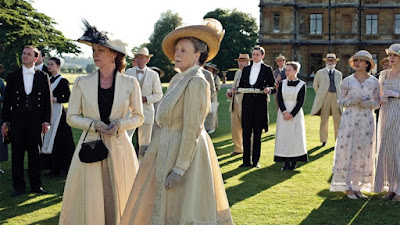
Downton Abbey: A New Era (2022) is a saccharine atrocity. Virtually all the characters are back from the final TV season, but they’ve had the blood squeezed out of them. The script leaves no one any dignity; the actors aren’t just actors anymore — they’re cardboard symbols of the resilient English spirit, diamonds of the Empire with stiff upper lips. This lame, pointless rip-off of Singin’ in the Rain (1952) is presented earnestly, as if nobody had ever heard of the silent-to-sound transition, and despite the fact that the film studio in the current story is the London-based producer of “quota quickies,” British Lion, all the characters keep mysteriously referring to their surroundings as “Hollywood.” What can you say about the writing in a movie that shamelessly treats all these dowagers, lords, ladies, and lackeys as wooden tokens of British class divisions and old-movie stereotypes (This Happy Breed [1944], Mrs. Miniver [1942], The White Cliffs of Dover [1944], and so on, where the only humor in the dialogue is inadvertent), or that relies on piled-up happy outcomes? I don’t remember a single moment in the two-hours-plus romance that was sexy or passionate, and when a baby is carried in at the end, I was baffled as to how it got there. At a time of our current upswing in erotic dramas in streaming programs, Downton Abbey: A New Era is presented as a chaste throwback to the sexless “family” entertainment of Joe Pasternak and Henry Koster. It’s a shame there isn’t a singing nun in it somewhere.

Static pose. Maggie Smith
The directing is truly primitive; scenes aren’t shaped for dramatic action or montage but for static tableaus. The camera pans slowly across each grouping of primped, posing characters while they deliver measured, mechanical dialogue: “We got through the war — we can get through this.” “You’ve been everything to me. Everything.” Lady Grantham sums it all up patly, in case anyone missed it: “Individual Crawleys come and go, but the family lives on.” This is the sort of sludge that E. F. Benson and Evelyn Waugh were making fun of in the thirties. Nobody raises his voice or spills his tea in this celebration of fortitude and tradition, and even Maggie Smith’s peppery dowager dragon from the TV show is defanged. (Where are all her tart one-liners? The director turns her into a snookums.) All the youngsters are paired off and squared off with clinical precision (the butler gets snapped up by a visiting movie star), but Dame Maggie is left spending most of the time in bed, thinking of an incandescent girlhood love, and we’re not sure whether she’s nobly remembering or just dotty. Dozens of details are either entirely phony or contrived to show off the landscape (the movie closes with a funeral procession that has rarely been equaled in the movies for frosty grandeur). Even the jazz band on the terrace is all wrong — it’s 1927 but the playing and singing sound like a contemporary cruise ship act. Downton Abbey: A New Era isn’t a family saga — it’s a commercial trade name, and Julian Fellowes makes a terrific living by appealing to his audience’s craving for wholesome blandness.