 |
| Toshiro Mifune and Keiko Awaji |
Wednesday, December 14, 2022
East and West

Wednesday, November 30, 2022
Bloodless
Downton Abbey: A New Era (2022) is a saccharine atrocity. Virtually all the characters are back from the final TV season, but they’ve had the blood squeezed out of them. The script leaves no one any dignity; the actors aren’t just actors anymore — they’re cardboard symbols of the resilient English spirit, diamonds of the Empire with stiff upper lips. This lame, pointless rip-off of Singin’ in the Rain (1952) is presented earnestly, as if nobody had ever heard of the silent-to-sound transition, and despite the fact that the film studio in the current story is the London-based producer of “quota quickies,” British Lion, all the characters keep mysteriously referring to their surroundings as “Hollywood.” What can you say about the writing in a movie that shamelessly treats all these dowagers, lords, ladies, and lackeys as wooden tokens of British class divisions and old-movie stereotypes (This Happy Breed [1944], Mrs. Miniver [1942], The White Cliffs of Dover [1944], and so on, where the only humor in the dialogue is inadvertent), or that relies on piled-up happy outcomes? I don’t remember a single moment in the two-hours-plus romance that was sexy or passionate, and when a baby is carried in at the end, I was baffled as to how it got there. At a time of our current upswing in erotic dramas in streaming programs, Downton Abbey: A New Era is presented as a chaste throwback to the sexless “family” entertainment of Joe Pasternak and Henry Koster. It’s a shame there isn’t a singing nun in it somewhere.
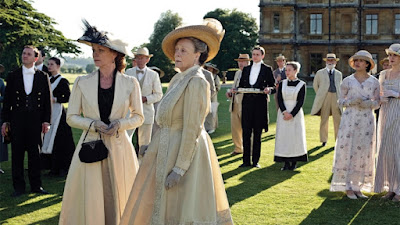 |
| Static pose. Maggie Smith |
Wednesday, December 29, 2021
Propaganda
Before he directed and starred in his marvelous Henry V in 1944, Laurence Olivier made several propaganda films for the war effort: That Hamilton Woman (1941) with his wife Vivien Leigh, in which Napoleon is a clear stand-in for Hitler, The Invaders (1941, 49th Parallel in the UK), with actual Nazis as Nazis, various Ministry of Information shorts, and The Demi-Paradise (1943). The latter, directed by Anthony Asquith, was intended to rouse British support for the Soviets in the wake of the 1941 German invasion, which abruptly terminated the German–Soviet non-aggression pact. (The title is from John of Gaunt’s deathbed speech in Act II of Richard II.) Olivier plays an Englishman’s idea of a Russian: officious and overwhelmingly critical of British reserve and “cruelty.” The screenplay (by Anatole de Grunwald) turns the proletariat Soviet engineer into a bourgeois provincialist — what has always been said about Englishmen — but Olivier is strangely listless. He overlooks the comic potential of the character, which is odd, considering Olivier’s triumphs in so many comic roles in the theater, from Sir Toby Belch to Sergius (Arms and the Man) to Justice Shallow. The artist who so successfully tapped the wit in a madman like Richard Gloucester should have, one would think, been inclined to play up the humor in Ivan Kouznetsoff. Olivier’s halting, overstudied delivery is perhaps a miscalculation. The effect on his characterization turns an engineer into an artistic temperament and gives the impression that Olivier has forgotten his lines. This may have been Olivier’s idea of Slavic dispiritedness.
 |
| Laurence Olivier |
Despite its occasional warm charm, including a lovely performance by Penelope Dudley-Ward and a brief bit by Leslie Henson in a music-hall number, the movie is prosaic and at least thirty minutes too long. A year later, Olivier’s heroic phase reached its artistic and commercial apex with Henry V, Shakespeare’s emblematic patriotic achievement and the British film industry’s glorious tribute to English empire.
Wednesday, November 3, 2021
Robert Altman’s Flying Machine
Brewster McCloud (1970), Robert Altman’s second feature film, is wildly fluid. Even fans of M*A*S*H (1969) might not be completely tuned in to this movie’s disjointed counterculture lightness. Scenes of episodic, oddball humor, visual shocks and sexual arousal (the movie was originally called Brewster McCloud’s Sexy Flying Machine) butt up against each other like pinballs, and Altman, who heavily rewrote the Doran William Cannon screenplay, is tilting the machine.
In M*A*S*H, the satire was equally manic but a lot clearer; scenes were constructed to puncture bureaucracy and skewer the military officers and aides who peddled it to the American troops. We know what’s going on in Brewster McCloud and we can catch all the often very funny movie references and in-jokes, but we don’t often know what those references are doing there or why a disparate group of Houstonians are being strangled. The movie doesn’t ever tell us why these particular victims were targeted or even who the killer is. It could be the sensual but mothering older woman (Sally Kellerman), the dimwit tour guide (Shelley Duvall, whose eyelashes are painted in Raggedy Ann spikes), or the taciturn Brewster himself (Bud Cort, who played several of his movie roles as if they were on the spectrum). Are the victims Brewster’s persecutors, establishment materialists threatening to derail his desire to fly, or are they only in the wrong place at the wrong time? The victims are all found contorted in grotesque shapes, with bird droppings on their bodies or faces, but if Altman is attempting to make a deeper satirical point and not just a scatological one, that point is lost. The comic visual scatology is everywhere, in fact: bird shit is constantly being dropped (by unseen birds) on important papers, wallets, badges, and windshields. The movie is practically awash in it. The freedom that Altman gives his cast to improvise dialogue saves a lot of the non sequiturs in the script — for example, while the suave detective (Michael Murphy) is examining one of the victims at a zoo, an enormous tortoise lumbers into the frame, nudging the detective’s right elbow, and Murphy, without losing character, says, “Somebody get this turtle out of here.” Moments like that reinforce the improvisational personality without adding to the confusion.
 |
| Weirdos. Shelley Duvall, Bud Cort |
This Is War, Not a Garden Party
You might walk out of the theater after seeing Gone with the Wind (1939) into
the cool, head-clearing night air feeling a little headachy. The first half is all epic and panorama. The last third is bogged down in expensive romance melodrama, an example of movie proto-fatigue. But the structure works in Wind’s favor: audiences are more energetic when the movie is likewise more energetic — for the first ninety minutes — so all that splendor isn’t wasted. Anyone inclined to wonder whether the mighty Wind really merits its eighty years of adulation usually just remembers the first half. When characters die, like Scarlett’s first husband, it’s sometimes treated comically, and good comedy is always memorable. Even dotty Gerald’s fatal fall from a horse is rather humorous, and I’ve heard audiences titter at his stentorian senility. In fact, all the enjoyable comedy in the movie occurs earlier, from the Peahen and Buffalo League (Laura Hope Crews, Jane Darwell, and Mary Anderson) to Uncle Peter (Eddie Anderson) to Charles Hamilton (Rand Brooks in baby curls) to the rollicking, blunt Mammy (Hattie McDaniel). The “intimate” melodrama of the last third is sodden soap opera and feels a little sour and disjointed (a script issue).
 |
| Father-daughter time. Vivien Leigh, Thomas Mitchell |
Gone with the Wind is meritorious for its saturated three-strip Technicolor, gaudy production design (including a number of famous matte paintings), pullback and crane shots against blazing sunsets and silhouettes of gnarled oaks, and actors who manage to stand out prominently against the size and scope of this cinematic gargantua. The power that the actors have, despite the lopsidedness the movie gives to production values, is miraculous. Clark Gable, Vivien Leigh, Thomas Mitchell, Olivia de Havilland, Leslie Howard, Butterfly McQueen, Victor Jory, Harry Davenport (“Good heavens, woman, this is war, not a garden party!”), Ward Bond, Alicia Rhett, and even brief scene stealers like Cliff Edwards, Paul Hurst (as the sinister Yankee deserter), and Eric Linden (the amputee who puts real terror in his scene and nearly upends the movie) make Wind a vivid personality parade. I guess that the actors’ all-around success is mostly attributable to the director, Victor Fleming, and the care David O. Selznick lavished on casting. By comparison, think of how many actors get swamped by the production in other humongous movies, from the Joseph L. Mankiewicz Cleopatra (1963) to David Lean’s Doctor Zhivago (1965) to James Cameron’s Titanic (1997) — none of them known for shimmering, zesty acting, the way Gone with the Wind is. Its performances weren’t just stellar but influential, too. Leigh’s Scarlett scared and inspired a generation of actresses after her, from Linda Darnell in Forever Amber (1947) and Hedy Lamarr in The Strange Woman (1946) to Elizabeth Taylor in Raintree County (1957), who copied her enigmatic combination of gusto and regal bearing.
The movie represents another miracle. After all its sweep and energy and calculated precision, it is, after all, an indie movie. Selznick International was an independent studio that nonetheless made movies the Big Studio way, filming prestige literary properties, building a stable of stars and directors, subcontracting stars from other studios, raising funds from East Coast banks and investors, and slathering movies with mass-production gloss without actually ever going into mass production (only a couple of Selznick movies were produced every year, from 1936 to about 1948). There isn’t much difference in the look of the typical Selznick movie and the big-budget movies from Warner Brothers or MGM: The Garden of Allah (1936), A Star Is Born (1937), Intermezzo (1939), Rebecca (1940), Spellbound (1945), and Duel in the Sun (1946) all look and play as if they came right off the major studio assembly lines. That’s their “personality.” Selznick was an intrusive, busybody producer who controlled every aspect of filming, usually driving his actors and directors nuts, and his movies both gain and suffer for it. The Selznick palette is broad and banal, but the details — including the performances — are often crazily energetic.
Tuesday, May 4, 2021
Moaning on the Prairie
 |
| Ophelia of the Prairie. Natalie Wood |
The movie, pitched for soapy hysteria, is both an idealization of misunderstood youth and a criticism of the impetuous promiscuity of high schoolers. Is Deanie, who goes mad, supposed to be a female James Dean in East of Eden (1955)? A teenage Blanche DuBois? Ophelia of the Prairie? The Inge screenplay won an Oscar, but it has much bigger problems than that. Incidentally, Phyllis Diller plays the notorious speakeasy owner Texas Guinan — she may be the stablest person in the cast — and Inge himself plays a reverend.
Saturday, December 5, 2020
Consuming Movies
Richard Brody, The New Yorker
Richard Brody treats movie art and movie consumption as two unrelated things, but movie art (a social art for a social animal) and the way movies are viewed have always been intertwined, and the health of one is tied to the health of the other — which Brody hints at when he says that “the rising tide of publicity and its echoes seems to lift all boats.” With nobody going to theaters this year — the Plague Year — we’re all watching movies on our iPads and phones and TVs. It’s a new dimension of experience for audiences, as Brody says. But I don’t think that consuming movies only in private isolation is going to enrich a popular art. Maybe you can even find the same kind of degradation in pop music and attribute it to the same changing patterns.
Many movies, like The Godfather (1972) or The Conformist (1970) or Star Trek II: Wrath of Khan (1982) — you could go on and on listing such movies — are great, immersive experiences that unleash their full power only in a theater with an audience, where visual dimensions can be appreciated in cinematic terms. The silent comedies, for example (Buster Keaton’s The Cameraman [1928] or Seven Chances [1925], Harold Lloyd’s Speedy [1928] or The Kid Brother [1927], Chaplin’s The Gold Rush [1925]), certainly deserve to be seen in a theater, a collective setting for which they were specifically designed. Those moviemakers intended audiences to feed off the explosive, balletic inventiveness and bust up at the visual gags and camera tricks. Those gags developed in live theater and vaudeville and probably circuses, and were extended and perfected by these artist clowns to make full use of the new medium. And an audience’s enthusiasm for silent comedy has as much to do with the responses of fellow moviegoers as with what’s on screen.
But imagine watching movies only in privacy or on your personal thingamabobs for the rest of your life. That changes you and that changes movie art. When your reactions are isolated from the reactions of others, the things you’re responding to don’t resonate with the same power; the effects are deadened, and you’re likely to assume that the moviemaker has failed, somehow, to make you laugh. Sooner or later, that “failure” gets back to filmmakers, who make contrived modifications in later projects — usually in kinetic, dizzying extremes in camera work or incompetent scripts — and, slowly, there’s an erosion of quality and sensibility. Movies started as a communal art, although they may not end as one.
Friday, December 4, 2020
Suckers
I managed with little effort to miss Twilight (2008) until very recently. I knew it was intended for a young adult audience (adapted from a wildly popular series of teen novels by Stephenie Meyer) and figured it probably didn’t have any of the macabre fun of the old Universal horror classics, but I was unprepared for the lurid look and the stoned, senseless rhythm (everybody’s face, human and vampire, is the same sickly gray-green, the same color as the landscape). It’s been awhile since I’ve seen something this mediocre take itself so seriously. It looks and sounds like an Eighties rock opera in some parts and an indie chamber drama in others, and it’s unrelenting. It’s also weirdly static. In many scenes, the actors just stand there, glancing around nervously, hesitating to deliver these awful lines while their mouths twitch, and you wonder whether they’re parodying youth or paying tribute to it.
 |
| Postpubes. Robert Pattinson and Kristen Stewart |
I can understand why this movie was such a huge hit. It feeds a primal longing not for shocks or gross-outs (the staples of most teen horror films) but for liberation from high school routines or smothering parents or middle-class values, and I think young audiences projected themselves onto the hip, confused characters. It’s vampire psychodrama. But it all seems the product of an unformed mind and personality; it could have used some comic subtext instead of all this lugubriousness — the two leads must have the heaviest eyelids since Robert Mitchum and Jane Russell in Macao (1952). The idea that some vampires don’t want to kill people and so resort to chasing after forest critters does have comic potential (remember how Dwight Frye’s eyes lit up when he ate juicy flies?), and the soundtrack works best when it ditches the gloppy score and incorporates some funky pop songs, but practically none of that potential is tapped. This movie bungles its chance to put the groove back in the undead — it could have been the best thing since Michael Jackson’s “Thriller.”
Thursday, October 15, 2020
Connections
In an epigraph, Wim Wenders dedicates Wings of Desire (1987) to Yasujiro Ozu, François Truffaut, and Andrzej Wajda, but in its imagery and tone, his movie has more in common with Fellini (Nights of Cabiria, 1957), Tarkovsky (especially Stalker, 1979), and the great Danish director Carl Theodor Dreyer, whose incandescent Day of Wrath (1943) and Ordet (1955) and Vampyr (1932) glide through dreamlike landscapes of pain and unfulfillment. Wings of Desire might have been called Wings of Longing — the angel Damiel longs to experience the physical connections of space and time that human beings have, while everywhere the human inhabitants of West Berlin, whose thoughts the angels can hear, long for various connections of their own: to parents or children, to spouses or lovers, to the past, and even to the self.
I think the film has a largely warm-hearted appeal, but its unspooling of interior dialogue (which reminds one of café jazz poetry) is intended to create an atmosphere of sweeping stream-of-consciousness — a sort of Jungian collective language of the Shadow — and I think we’re really not supposed to “interpret” or explicate the arcane prose-poetry. Taken individually, each mental utterance sounds like a bromide, and the overall effect can be deadening if, like Damiel, you’re searching for connections. (Rilke apparently inspired much of Peter Handke’s screenplay.)
The angels see this earthly realm in monochrome when they’re most removed from human experiences. But the end of the picture explodes in color as Damiel “crosses over” (in an amusing bit, he sells his angelic breastplate in an antiques store). Damiel is obsessed by his attraction to the trapeze artist and the lusty simplicity a group of children take in a circus performance. He longs to feel what they all feel, and his desire has a childlike naïveté; he doesn’t seem to recognize the unfortunate side of earthbound mortality.
 |
| Angelic observer. Bruno Ganz |
In a way, the lack of linguistic coherence works in the movie’s favor. The compression of time in traditional narrative is almost entirely abandoned, and you do feel as if you were floating around Berlin with the angels without a sense of beginning, middle, or end — the rising action, climax, and denouement of dramaturgy. You expect temporal and even spatial constructions that just aren’t there, and you may get caught searching for phantoms. The movie might have made a great impact as a silent classic with few title cards, although you’d miss the eerie, evocative score. When the theorists talk of “pure cinema,” they may have something like this in mind. Fairly early on, Wenders gets you to feel cut adrift, like a buoy, from spatiotemporal anchors (the movie subverts your geographic information system). The camerawork is remarkable — it seems unbound by space the way the pacing seems unbound by time. Did the cinematographer (Henri Alekan) use cranes and a Steadicam (which Kubrick used in The Shining in 1980) for all those marvelous aerial tracking shots? Alekan’s work unifies this model of personal filmmaking — it’s transporting. Irrespective of the otherworldly elements, the movie’s experimental spirit takes you right to the core of some timeless human questions.
Sunday, October 4, 2020
Codgers
Watching Lindsay Anderson’s shameless The Whales of August (1987) is like being in a mausoleum. But the more energetic scenes are akin to rummaging around in the attic of the Haunted Mansion. This mélange of codgers — Lillian Gish and Bette Davis and Vincent Price and Ann Southern and Harry Carey Jr. — is rather ghoulish; the script drones on and on about the past, and before long you’re not entirely sure whether you’re looking at the actors in real time or at newsreel footage of dead movie stars. I kept expecting a Eugene O’Neill play to erupt at some point, with recriminations and accusations and booze late into the night, but the only thing that really happens is that the floors creak.
I don’t remember whether there were any whales, but Vincent Price catches some fish, though God knows how, considering that he doesn’t appear to have the coordination to cast his line into the surf without falling off the rocks. I’ve read that many old stars, from red giants like Barbara Stanwyck and Joel McCrea to white dwarfs like Fred Astaire to black holes like Shirley Booth, were asked to take part but turned it down. Why would an old fart whose movie career is a distant memory return to the screen in this — an adaptation soaking in formaldehyde of a play that embalms its characters before they’re laid out on the coroner’s table?
What is an actor at any stage of life supposed to do with lines like “Photographs fade, but memories live forever”? The dialogue is all mothballs and tea rose: “I have once again been set adrift.” — “Oh, I’m sorry, Mr. Maranov.” — “Oh, you needn’t be, my dear. I have often been adrift, but I have always stayed afloat.”
 |
| Silver treasures. Gish and Davis |
A little later, the on-screen embalming is stiffer than ever: “Do you think one can live too long?” — “Life can never be too long.” — “Even if one outlives one’s time?” — “One’s time is all one’s time, even to the end. You see out there, how the moon casts its silver treasures along the shore? There is a treasure that can never be spent.”
Sic transit Lillian and Bette.
Subscribe to:
Posts (Atom)